
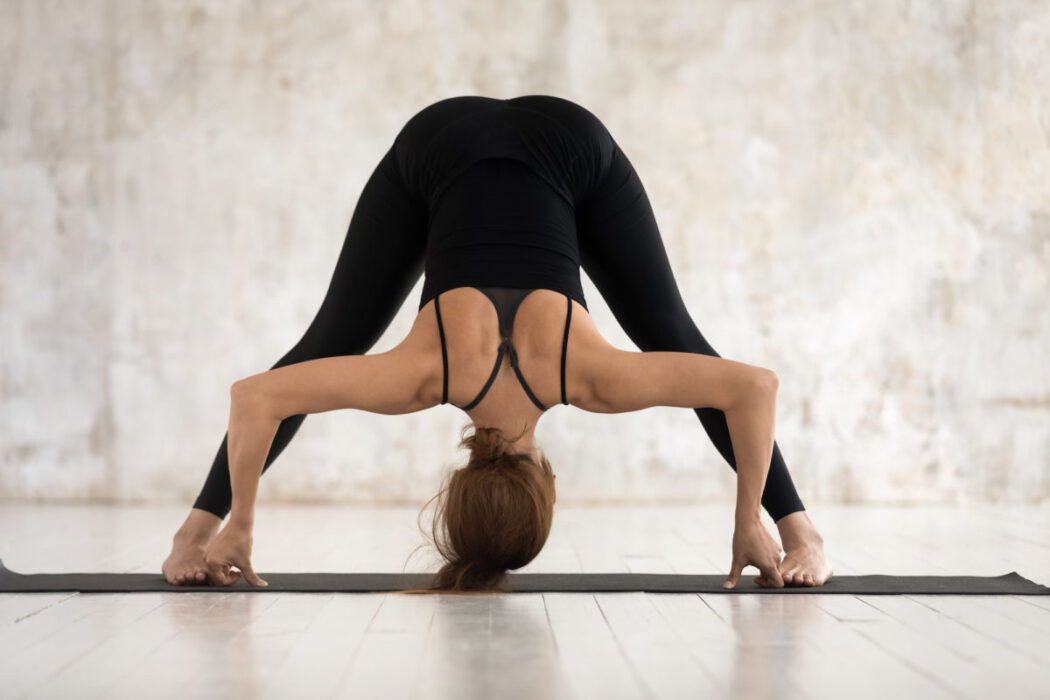
20 Mar How to Fold Forward Safely (Yoga in Heston, Hounslow)
Forward folds, or flexions, are often celebrated as the ultimate restorative poses in yoga. They are designed to draw the senses inward and quiet the mind, making them a perfect antidote to a stressful day. However, without the correct technique, they can easily lead to strain in the lower back or the delicate tissues behind the knees. A safe fold is not measured by how close your nose gets to your shins, but by how well you maintain the integrity of your spine.
Defining the Technical Terms
To understand how to fold safely, it helps to be familiar with the anatomical language used in class. Flexion is the term for a movement that decreases the angle between two body parts, such as folding the torso toward the legs. The hamstrings are the large muscles running down the back of the thighs, which are often the primary source of resistance in these poses. The pelvis is the bowl-like bone structure at the base of your spine that should act as the main hinge for the movement.
The sit-bones, or ischial tuberosities, are the lower parts of the pelvis that you feel when sitting on a hard chair. In a fold, these should ideally point up or back. Finally, the intervertebral discs are the shock-absorbing cushions between your vertebrae. If we fold by rounding the back excessively, we risk putting uneven pressure on these discs.
Hinging from the Hips
The most vital principle of a safe forward fold is ensuring the movement starts at the hip joints rather than the waist. You can imagine your pelvis as a bowl full of water. To fold correctly, you want to tip the bowl forward so the water spills out over your toes. If the bowl remains upright and you simply slump your shoulders forward, you are essentially “breaking” the line of the spine at the lower back, which can lead to long-term discomfort.
A helpful way to find this hinge is to place your hands on your hip creases as you begin to fold. You should feel the torso folding over the thighs while the spine stays relatively long. By leading with the chest rather than the forehead, you encourage the upper back to remain spacious rather than collapsed.
The Power of Bending the Knees
There is a persistent myth in yoga that the legs must be perfectly straight for a fold to be “correct.” In reality, keeping a generous bend in the knees is often the safest and most effective way to practise. Bending the knees releases the tension on the hamstrings, which in turn allows the pelvis to tilt forward more freely.
This simple adjustment takes the strain off the lower back and ensures that the stretch is distributed safely through the muscle belly rather than pulling on the tendons where they attach to the bone. Over time, as your flexibility increases, you may find the legs naturally begin to straighten, but this should never be forced at the expense of your spinal alignment.
Working with the Breath and Gravity
In forward folds, the breath acts as both a tool and a safety gauge. As you inhale, try to find a little more length in the front of your body, and as you exhale, allow gravity to draw you deeper. You should never use the strength of your arms to pull yourself down into a fold. Yanking on your feet or shins creates a “tug-of-war” in the body that can lead to micro-tears in the muscles.
Your edge is the point where you feel a productive stretch but can still maintain a slow, steady rhythm of breathing. If you find your breath becoming shallow or if you are clenching your jaw, it is a clear signal from your nervous system to back off slightly. The goal is a state of active surrender, not a forced conquest of the toes.
Entering and Exiting with Grace
In a standing fold like Uttanasana, keep your weight slightly forward toward the balls of the feet. Many people lean back into their heels, which can lock the knees and put the hips out of alignment. If you are practising a seated fold, such as Paschimottanasana, sitting on the edge of a firm cushion or a folded blanket can help elevate the hips and make the forward tilt of the pelvis much more accessible.
When it is time to come out of the pose, do so slowly to avoid a sudden drop in blood pressure. In a standing position, it is often safest to bend the knees deeply, tuck the chin, and roll up through the spine one vertebra at a time. This ensures that the back muscles remain relaxed and supported as you return to an upright position.
No Comments